

I use coding agents every day, and I believe the productivity gains are real.
Not hypothetical. Not visible only in a benchmark. Real.
I can explore an unfamiliar codebase faster. I can turn an idea into a working prototype on a whim. I can delegate the tedious middle of a task—the scaffolding, the tests, the documentation, the repetitive refactor—and spend more of my attention on architecture and judgment. Things that once took days sometimes take hours. Things I would never have done at all are now sometimes worth a one-shot prompt that burns tokens while I focus on other things.
This is usually where the argument about AI and productivity gets stuck. One side says the tools are transformative. The other says they produce slop, hallucinate, create security problems, and leave behind code no one understands.
Both sides have evidence. Neither gets to the heart of the problem.
Even if we grant the strongest version of the optimistic case—even if agents make software engineers two, five, or ten times faster at producing code—it does not follow that they will produce a corresponding increase in profits, wages, useful goods, or GDP.
The reason is simple: the productivity of a worker is often decoupled from the productivity of the system they work inside.
And code was rarely the real bottleneck.
A faster step is not a faster system
Software engineers do not work in a vacuum. Code sits inside a long chain of decisions: What should we build? Does anyone want it? Can legal approve it? Can sales explain it? Will customers adopt it? Can the organization maintain it? Does it fit the strategy? Is anyone empowered to say no?
An agent can compress the coding step while leaving every other constraint untouched.
It should be immediately clear that this is basic systems thinking. If one station on an assembly line becomes ten times faster, the factory does not become ten times faster. Work simply piles up at the next station. In software, that pile might appear in code review, testing, security, product approval, deployment, support, or customer adoption. It may also appear as a swelling backlog of plausible features that nobody needed badly enough to prioritize before they became cheap to build.
The engineer feels dramatically more productive because more code is being produced. The organization may feel no more productive at all.
It may even become less productive. Every new feature creates future obligations: maintenance, documentation, security patches, user education, compatibility, and eventual deletion. When the cost of creating software falls faster than the cost of understanding and maintaining it, organizations can accumulate code the way households accumulate cheap plastic objects. Exactly that way, actually, as we’ll see in a moment.
Production rises. Coherence falls.
This is why the flood of vibe-coded apps is less economically significant than it first appears. AI has made it possible to manufacture software without first establishing that anyone needs it. The app store can fill up while demand stays exactly where it was.
Scarcity has moved. Code is cheaper. Attention, trust, distribution, judgment, and genuine demand are not.
I’m grateful to work at a start-up that has this more figured out than any previous employer I’ve spent time with, but I have serious doubts that the vast majority of knowledge workers whose roles have been facilitated through agents are in the same lucky boat as me. We’re devoting deep thought to this regularly, and as a tiny team we have the ability to be agile and adapt our methods. Agility is far from a given across a business world rife with red tape, politics, entrenched legacy processes, and plain old inertia.
The uncomfortable question behind “bullshit jobs”
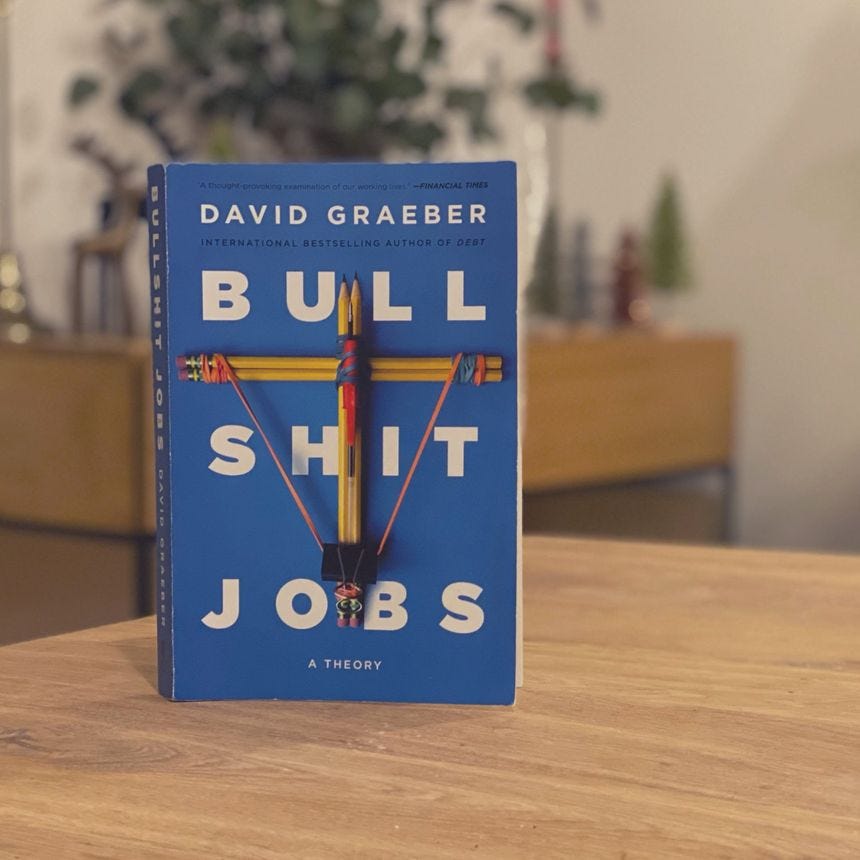
David Graeber’s Bullshit Jobs is useful here, even if you do not accept every part of his argument. His provocation was not merely that some jobs are unpleasant or bureaucratic. It was that many workers privately suspect their role should not exist—that if it vanished, the world would be no worse and might in fact be better.
The exact prevalence is debatable. The experience is recognizable.
Large organizations contain enormous amounts of activity whose relationship to the stated mission is indirect, ceremonial, defensive, or even impossible to explain. Reports are produced because another report depends on them. Meetings are held to prepare for later meetings. Teams build internal tools to compensate for processes that nobody is allowed to change. Managers translate between layers of management. Workers learn to narrate motion as impact because motion is what the organization can measure.
Now give everyone an AI assistant.
The assistant can make the report faster. It can summarize the meeting, draft the follow-up, generate the dashboard, write the glue code, and produce a polished explanation of why all of this matters.
But if the underlying activity was weakly connected to value, accelerating it does not strengthen the connection. It only helps the organization perform the meaningless rituals more efficiently.
That is the part missing from most forecasts of AI productivity. They assume that work is a pipe carrying value, so increasing the flow of work increases the flow of value. But much of modern knowledge work is not a pipe. It is a maze. Helping people run faster through the maze does not necessarily get anyone closer to the exit.
Productivity for whom?
Even where AI creates real savings, another question follows: who receives them?
Suppose an engineer can now finish a week’s assigned work in two days. Several outcomes are possible.
They might work two days and receive the same pay, reclaiming three days for family, community, art, rest, or civic life. That would be a profound improvement in human welfare. It would barely register as GDP growth.
The company might respond by assigning more work, increasing output without increasing pay. If customers want that additional output, the company may capture the gain as profit. If they do not, the result is simply more features, more internal complexity, and a busier roadmap.
The company might reduce headcount while producing the same output. That is a genuine increase in labor productivity on paper, but its social meaning depends on what happens to the displaced workers, the savings, and the prices customers pay.
Or nothing formal might change. The worker may use the saved time to absorb the coordination, ambiguity, and administrative burden that already surrounded the job. The agent makes coding faster, and the organization quietly expands everything else until the calendar is full again.
“Productivity” hides all of these possibilities inside one flattering word.
GDP makes the ambiguity worse. It is a measure of market production, not a scoreboard for usefulness, dignity, leisure, ecological health, or human flourishing. A tool that lets millions of people repair their own appliances, teach themselves a skill, or build small programs for their own use may create enormous value while replacing transactions that once counted toward GDP.
Even Meta’s persistent agent, Muse, has received praise and marketing around its ability to cancel unwanted subscriptions and chase down customer service for refunds. Good for the individuals using it, but unless the data Meta is undoubtedly collecting is worth more than the savings, the loss of those dark UI dollars is, in a small way, damaging to an economy that has become bloated and dependent on deception.
And if AI is only used to speed up the status quo? A tool that generates millions of unwanted subscriptions, advertisements, and disposable enterprise features can increase measured activity, but it is actually making life pointlessly noisier.
The metric of GDP and the buzzword of productivity answer a narrower question than the ones we keep asking them.
The economy of manufactured urgency
This leads to the darker possibility.
Perhaps long working hours are not merely an unfortunate cost of economic production. Perhaps, for a large part of the economy, they are also a source of demand.

When people have no time, they need what Fight Club mockingly called “convenient solutions to modern living.”
They need meals delivered because they cannot cook. They need rides because walking or public transit takes too long. They need housekeepers because weekends are for recovering from the week. They need subscriptions, organizers, productivity systems, prepared foods, expedited shipping, and a small army of apps to coordinate the life they no longer have time to live.
I spent nine years in the service industry. None of this is an argument that service work is unnecessary, or that the people doing it deserve less. Quite the opposite. Essential workers deserve relief too. The point is that many services meet needs created or intensified by the structure of work itself.
We work to earn enough money to purchase substitutes for the time that work took away.
Then we—or someone important-sounding who is decidedly not us, not feeling the downstream loneliness, anxiety and depression—counts every exchange as growth.
This does not mean every convenience is fake, every job is pointless, or capitalism operates through a single conspiracy to keep everyone busy. The mechanism does not require a conspiracy. Each company needs growth. Each manager needs a roadmap. Each worker needs income. Each household adapts rationally to its time constraints. The system can manufacture urgency without anyone consciously designing it to do so.
AI enters this system promising to give us time back. But a company organized around growth cannot easily accept the conclusion that less work is now necessary. Saved time must be converted into more output, a larger scope, a leaner workforce, or a new category of consumption. Otherwise the gain may be real for human beings but invisible—or even threatening—to the institutions that measure success through revenue.
The supply of software is not the demand for software
This is why I am skeptical that vibe coding, by itself, will move GDP in the way its advocates imagine.
The supply of software is exploding. But supply does not manufacture durable demand simply by existing.
Most people do not need another habit tracker, AI wrapper, personalized dashboard, or app that performs one narrow task slightly differently. They may try one. They may admire the demo. They may even pay for a month. But novelty is not the same as economic value, and the ability to ship is not the same as the ability to matter.
When building becomes nearly free, the valuable work shifts upstream and downstream: choosing the right problem, earning trust, reaching users, integrating into real institutions, supporting the result, and deciding what should not be built.
Agents are excellent at turning specifications into artifacts. They are less capable of deciding which specifications deserve to exist. That decision is social and political before it is technical. It depends on whose needs count, who has purchasing power, who bears the maintenance cost, and who is allowed to change the system rather than merely add another layer to it.
This does not mean AI will have no effect on GDP. It already drives spending on chips, data centers, energy, software subscriptions, and infrastructure. It may create valuable products, lower prices, reorganize firms, and eventually show up in broad productivity statistics. General-purpose technologies often take time to diffuse because organizations must redesign themselves around new capabilities.
But that is precisely the point. The transformation will not come from producing the same work faster inside institutions that remain otherwise unchanged.
It will come, if it comes, from changing the institutions.
But how?
The real promise of AI is not more work
The most interesting possibility is not that AI allows us to produce ten times as much software. It is that it reveals how much of our current labor was never necessary.
That possibility is economically awkward because our social contract still ties income, healthcare, housing, status, and the right to participate in society to having a job. We say work is how people contribute. But when the contribution becomes difficult to identify—when even the worker cannot explain who benefits from the output—the moral logic starts to wobble.
Reciprocity is a reasonable principle. People who benefit from a society should contribute to it when they can. But employment and contribution are not synonyms. Caring for children, supporting a neighbor, making art, restoring an ecosystem, maintaining a community, and participating in democracy all create value. Much of that value is poorly paid or not counted at all. Meanwhile, plenty of highly compensated activity exists mainly to help one institution outmaneuver another.
AI makes this contradiction harder to ignore.
If a machine can remove half the labor from a task without reducing the value produced, the humane response would be to ask how to distribute the time. Our default response is to ask how to fill it.
That is not a technological limitation. It is a political choice. It is not even economic necessity.
So yes, I believe agents are making workers more productive. I experience it myself. But worker productivity will not automatically become firm productivity, and firm productivity will not automatically become shared prosperity. Between those layers sit management, market demand, ownership, bargaining power, and the peculiar requirement that every saved hour find a new way to justify itself.
Vibe coding will not transform the economy simply by making code abundant. Code was already far more abundant than attention, trust, care, meaning, or time.
The question is not whether AI can help us do more.
It is whether we can build a society capable of wanting less work—and letting people keep the difference.