

My last piece pitched the AI Siesta: noticing when my capacity to discerningly judge vibes has begun to contract, even while the machines around me remain perfectly willing to accelerate.
As I’ve discussed the piece with readers over the last week, it’s occurred to me: the lesson here is not exactly about about stopping.
Instead, it’s about trusting that a wave that withdraws will eventually explode out again.
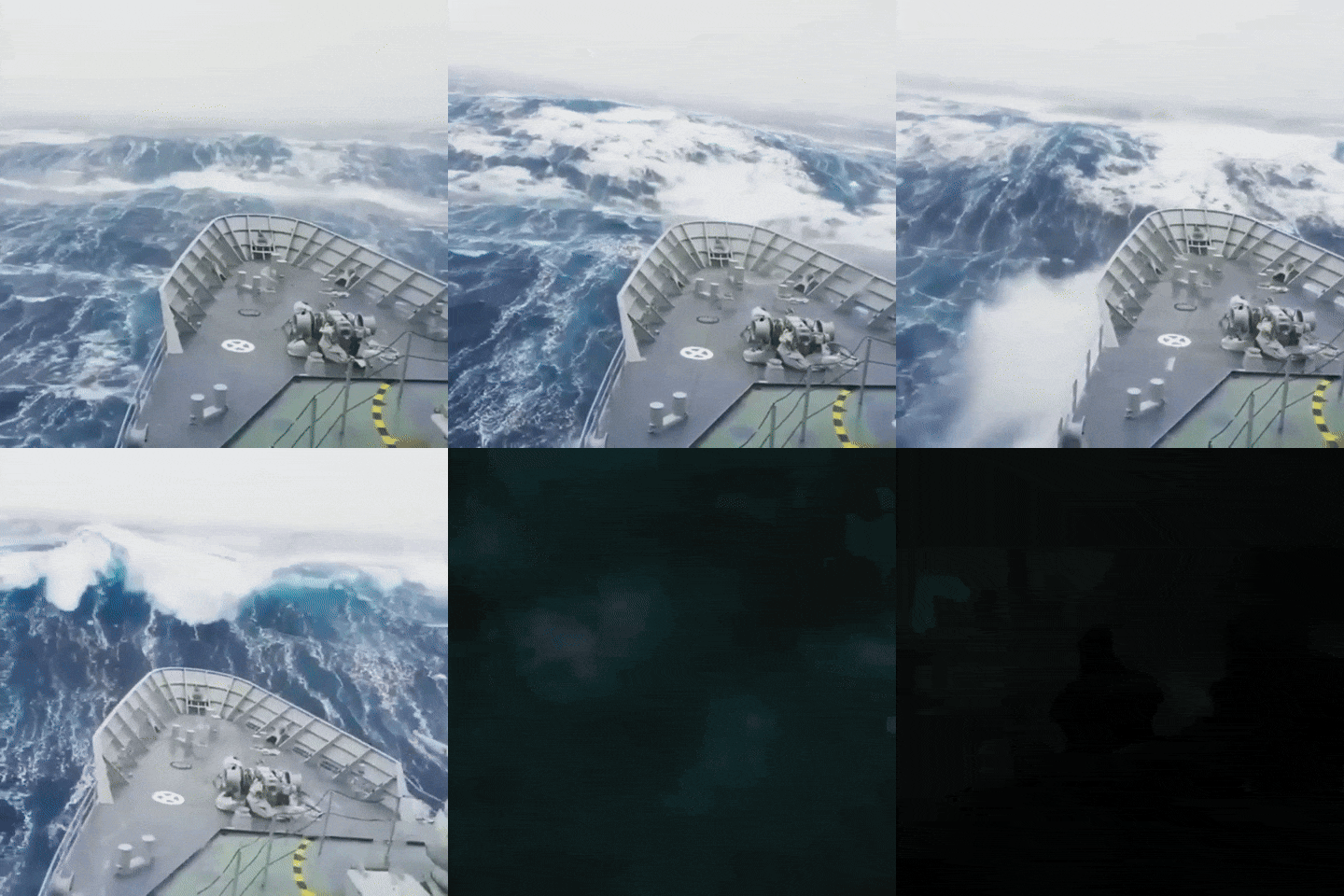
Waves of Dukkha, Dukkha as Stress
Some stress feels good. A hard workout ends in exhaustion, but the exhaustion codes as satisfaction rather than alarm. The soreness is not evidence that the system failed. If it crosses the border into “pain” that’s information to adjust your routine to. But within the right limits, baseline soreness is simply evidence that the system encountered a demand, responded, and now needs to integrate what happened.
Exercise does not merely build the capacity to lift heavy stuff or move fast. Though listing heavy stuff and moving fast are fun and rewarding. Exercise gives us repeated practice moving through exertion into contraction without interpreting the contraction as catastrophe.
That distinction has been following me around.
Exercise may train us to feel satisfaction about exhaustion rather than aversion to it. I happened to open the Orange section of my Work in Progress APTITUDE course material for proofreading after the gym and found the same idea waiting for me—my past self showing the building blocks of my current argument: there was exercise as a controlled stressor, a way of building capacity, regulating energy, and grounding agency in the body.
Call it synchronicity, selective attention, or an unusually cooperative algorithm. Either way, the pattern had become bold enough to notice.
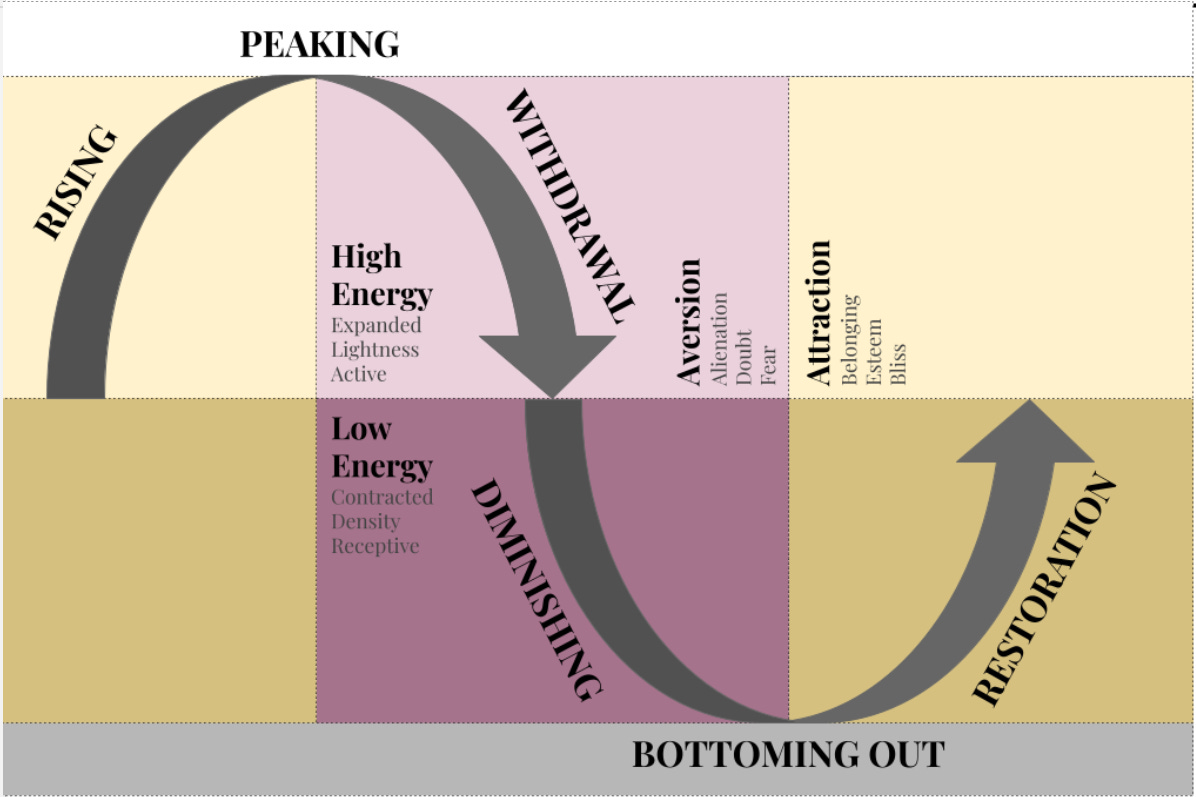
The Archetypal Wavelength describes six recurring phases: Rising, Peaking, Withdrawal, Diminishing, Bottoming Out, and Restoration. I see them in projects, moods, relationships, organizations, creative work, and increasingly in a single day spent building with AI.
Society has equipped many of us with a preference for Rising. Rising has obvious affordances. Start the project. Add the feature. Increase the load. Follow the energy. Peaking is legible too, especially in a culture that likes launches, records, breakthroughs, and clean upward graphs.
The trouble begins when the wave turns.
Withdrawal and Diminishing can feel like betrayal. Yesterday I could carry this. Why can’t I carry it today? The reflex is to recover the peak by force: another prompt, another set, another meeting, another stimulant, another attempt to solve the quagmire without leaving it.
But a wave that never contracts is not a wave. It is a line drawn by someone who has not waited long enough.
Donella Meadows helped me see why this matters beyond metaphor. Systems contain stocks, flows, delays, and feedback loops. Energy is a stock. Attention is a stock. Trust, morale, and ecological resilience behave like stocks too. We can draw them down faster than their replenishment signals become visible. By the time a system tells us plainly that it is depleted, we may already be well into overshoot.
The urge to preserve the peak is therefore not just a personal quirk. It is a systems error: acting on delayed information as though the earlier conditions still hold.
Exercise offers a small laboratory for correcting that error. The load is real, but bounded. The contraction arrives, but it has a context. Rest belongs to the protocol. Over time the body learns something the planning mind resists: capacity is not the absence of stress. It is the ability to meet stress, receive its information, and recover without turning every downward movement into an emergency.
This is where my loose translation of dukkha as “stress” needs care. In Buddhism, dukkha is not simply difficulty, effort, or pain. The First Noble Truth does not say that every unpleasant sensation is bad and should be engineered away. It points toward the instability and unsatisfactoriness that arise when we cling to changing experience as though it could be made permanent.
The workout burns. The productive streak ends. The mind fogs. The project enters a less glamorous phase. Those conditions may be painful. But another layer of suffering appears when I insist: this should not be happening; I should still be at the peak; contraction means something is wrong with me.
Tara Brach often teaches this through the image of the second arrow. The first arrow is the unavoidable pain of experience. The second is what the mind adds through blame, resistance, and identity. In systems language, the first arrow is a disturbance. The second arrow is the reinforcing loop we build around it.
That loop can make the low lower.
When things are going poorly, don’t panic - Chogyam Trungpa Rinpoche
Fatigue produces aversion. Aversion produces panic and self-judgment. Panic drives more forced effort or total disengagement. Both create more fatigue, which appears to confirm the judgment. Soon a natural phase of the wave has been promoted into a story about the whole self.
The alternative is not attraction to suffering for its own sake. There is no virtue in ignoring injury, overload, exploitation, or a system designed to consume people. “Welcome the contraction” can become cruel very quickly if it is spoken by the person imposing the load.
The more useful practice is discernment.
What kind of stress is this? Is it a bounded challenge that can increase capacity, or an extraction that is degrading it? Is this Withdrawal asking me to reflect, Diminishing asking me to release, Bottoming Out asking me to surrender an old strategy, or Restoration asking not to be hurried?
Carl Jung’s idea of archetypes matters to me here not as a cast of fixed characters, but as a way of noticing forms that recur across otherwise different lives. The Wavelength is “archetypal” in that sense. It is not a prediction that tells me what happens next. It is a pattern language that helps me locate myself inside change.
That changes the emotional meaning of the low.
If I mistake every contraction for a permanent state, I either fight it or become it. If I can recognize it as a phase, I can participate in it. I can stop demanding Rising behavior from a system in Withdrawal. I can let Restoration restore instead of immediately converting new energy into more obligations.
This is also the deeper promise I see in the Orange practice. Agency is not endless expansion. It is the growing ability to remain in relationship with the whole cycle. To act when action is available. To stop when stopping is intelligent. To distinguish the soreness of adaptation from the pain of damage. To avoid turning either one into an identity.
The AI Siesta was my attempt to catch the moment of Withdrawal before a productive afternoon became an exhausted night.
What I am learning now is that the pause is not outside the work. Neither is the contraction. They are phases through which good work becomes integrated, sustainable, and eventually alive again.
The goal is not to stay at the top of the wave.
It is to become someone who can ride the whole thing.